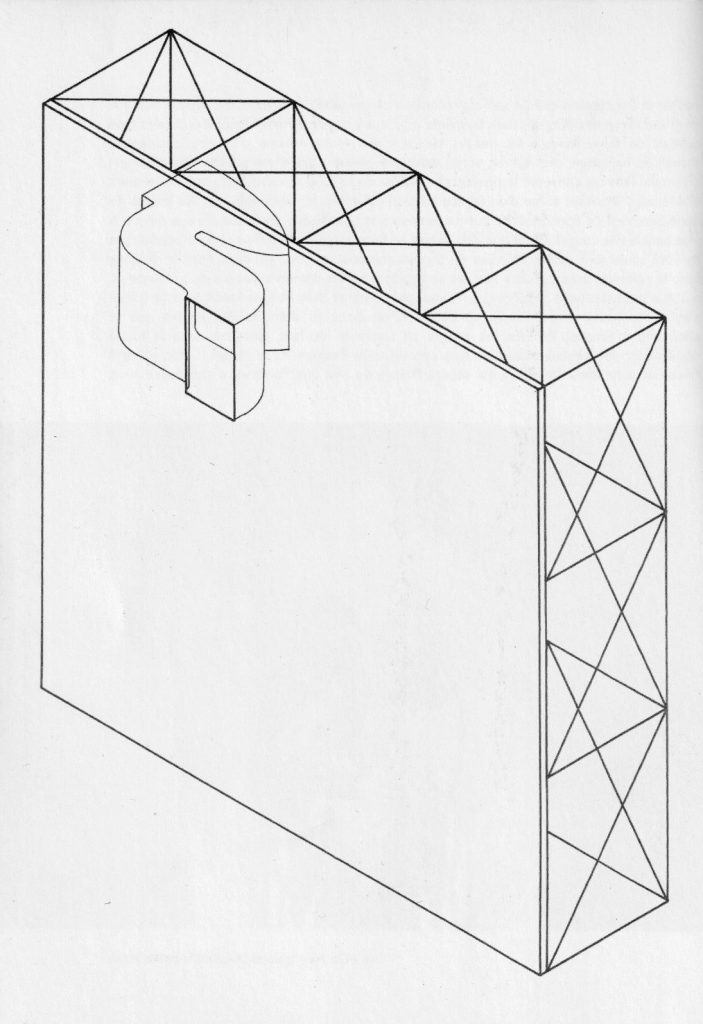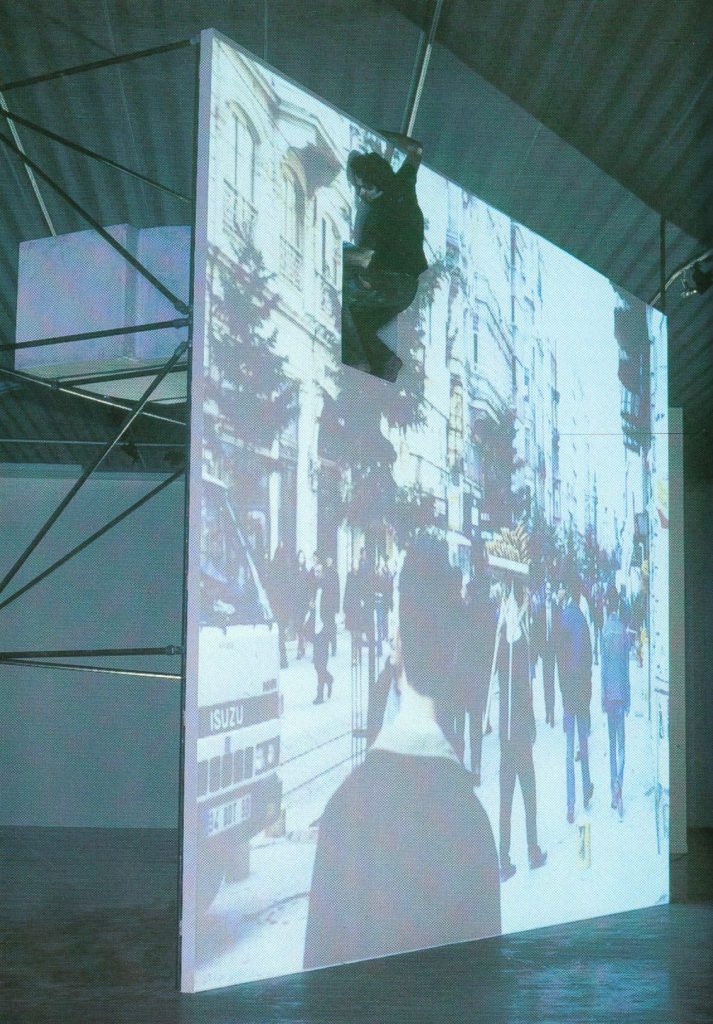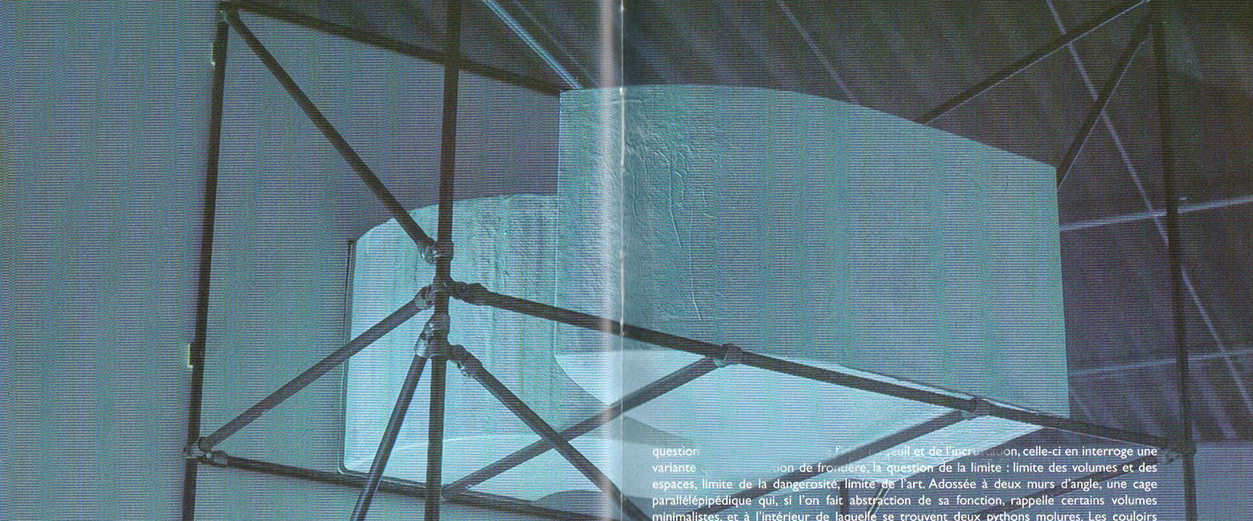
de Denis Pondruel, 2001 (performance for a sculpture)
Chambre/Istiklâl Cad.
…
The turning point in Pondruel’s work came when he gave up adding objects to what already exists in the world and decided, on the contrary, to empty objects out, to give an example of hollowing: the emptiness of familiar form. And yet, you will say, he is still producing and presenting objects and not just any old objects, either!! For what could be more object-like, more arrogantly objectal, than the steel parallelepiped that he installed just outside the museum at Heidenheim (Germany), giving it the title Kammer im Kunstwerk (Room in an Artwork)? Yes, but emptiness is precisely that: a space with solidity around it.
…
This hollowing-out process pursued by Pondruel for some five or six yeas now reached a new stage with the projects undertaken jointly for Istanbul, Amiens and Colmar. For while the Seuils constituted the very principle or, in a sense, concept of excavation, and if the three-dimensional pieces can be read as so many confrontations with the density of the real, then here we reach the stage of representation, of the image of the world and its support, that is to say, the flatness of the screen. Although these works use the most up-to-date technology and means of communication (Internet), their principle is simple as regards both their conception and the result perceived by the public. In Istanbul, a big screen showed images captured in real time in Amiens using a CCTV-type camera: video images of an urban crowd in western Europe shown in an art gallery in a big town in eastern Europe. Then the process was reversed: now the Istanbul crowd could be seen without delay on an imposingly large screen set in an Amiens cultural centre. In both places, the images are everyday: nothing spectacular, apart from the absolute spectacle that is the image itself, even the most banal of images. Whatever we may be led to think, real time does not produce anything real, only different kinds of aural and visual representation, whose separateness from their referent, although paper thin, remains very much a reality and, for anyone concerned to avoid the kind of madness that consists in confusing image and object, a vital one.
in Inside, notes on the sculptures of Denis Pondruel, by Jean-Marc Huitorel